Have you ever wondered why a seemingly identical date costs differently across shops, regions, and even months? Date prices are not random. As a price-reference site, we traced the chain from overseas farms to Indonesian shelves and distilled the seven factors that set date prices most strongly in 2026. Understanding them helps you judge whether an offer is reasonable or overpriced.
Summary: The Weight of Each Factor
| Factor | Direction | Estimated Price Impact |
|---|---|---|
| Rupiah vs dollar/riyal | Weaker rupiah → higher price | High |
| Import duty & costs | Up → higher price | Medium |
| Variety & grade | Higher grade → higher price | High |
| Country of origin | Varies | Medium-High |
| Logistics & supply chain | Costs up → higher price | Medium |
| Season (Ramadan/Eid) | Demand up → higher price | High (seasonal) |
| Sales tier (retail/wholesale) | Wholesale → lower per-kg | Medium |
1. The Rupiah Against the Dollar and Riyal
Nearly all dates in Indonesia are imported from Saudi Arabia, Egypt, Tunisia, Iran, and Palestine, so the exchange rate is pivotal. When the rupiah weakens against the US dollar, the cost of imported goods automatically rises and is passed into selling prices. This is the structural factor importers find hardest to avoid.
2. Import Duty and Administrative Costs
Every imported good carries extra costs, not just the duty itself but also document handling, permits, and more complex logistics driven by regulation. These are borne by the importer and ultimately reflected in the consumer price. Changes in import tariff policy can shift date prices across the whole market.
3. Variety and Grade
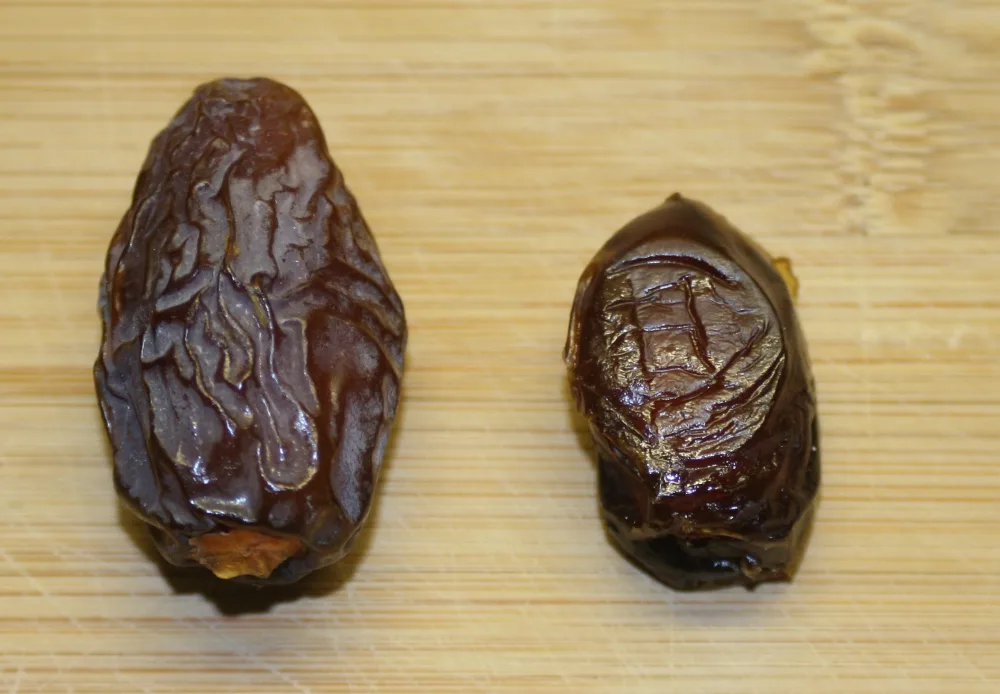
This is the factor you feel most on the shelf. Premium varieties like Ajwa and Medjool cost far above Sukari or Egyptian dates. Even within one variety, grade sets the price: larger, uniform, intact fruits fall into grades A, AA, AAA, up to VVIP Jumbo, with per-kilogram prices climbing alongside the grade. The table illustrates the general pattern for a single variety.
| Grade | Traits | Relative Price Index |
|---|---|---|
| A | Standard size, uniform | 100% |
| AA | Larger, fewer defects | 115–130% |
| AAA / VIP | Large, very uniform | 140–170% |
| VVIP / Jumbo | Largest, premium | 180–220% |
4. Country of Origin
Each origin brings different reputation, production costs, and shipping distance. Per 2025 data, Indonesia imported 54.45 thousand tons of dates worth US$67.8 million, with Egypt the largest supplier (24,232 tons), followed by Saudi Arabia (11,511 tons) and the UAE (7,654 tons). Egypt leads on volume at friendly prices; Saudi Arabia brings premium religious varieties like Ajwa; while Tunisia and Iran fill the mid-segment.
5. Logistics and Supply Chain
Shipping, insurance, storage (including cold storage for fresh dates), and domestic distribution all pile into the final price. The longer the chain — importer, distributor, agent, retailer — the more margin attaches. Buying closer to the source (directly from an importer) trims these layers.
6. Season: Ramadan and Eid
Date demand surges before Ramadan. Imports begin rising about five months ahead of Ramadan and Eid al-Fitr; in January 2025 alone imports reached 16.43 thousand tons worth US$20.68 million. On the retail side, prices often rise before Ramadan and do not fall immediately after Eid. At Tanah Abang market, Sukari rose from IDR 70,000 to IDR 90,000/kg ahead of Ramadan 2026. In short, timing strongly affects price.
7. Sales Tier: Retail vs Wholesale
The same date can differ drastically depending on whether you buy single units or in bulk. Buying wholesale lowers the per-unit price, because distributors apply pre-calculated discounts. This is why resellers and event committees always chase wholesale rates. See our wholesale price guide to understand the retail, wholesale, distributor, and importer tiers.
How to Apply This When You Shop
- When the rupiah is strong and Ramadan is far off, prices tend to be most stable — a good time to stock up.
- Always compare prices per kilogram and at an equivalent grade.
- For large needs, ask for the wholesale price; the gap can be tens of percent.
- Buy from sources that transparently state variety, grade, and country of origin.
Case Study: Why Sukari Rose IDR 20,000/Kg Before Ramadan 2026
To see these factors working together, consider a real case: Sukari ahead of Ramadan 2026. At Tanah Abang market, Sukari jumped from IDR 70,000 to IDR 90,000 per kilogram — a rise of about 28% in just weeks. What happened? Several factors stacked at once: season (pre-Ramadan demand surged to about eight times normal volume), supply chain (stock moved fast, so traders held prices higher), and sales tier (many buyers suddenly shifted to retail instead of planned wholesale). It is a perfect illustration that a date price is the result of several interacting factors, not one single cause.
Commonly Misunderstood Factors
A few mistaken assumptions are worth correcting so you can judge prices more accurately:
- "Imported dates must be pricier than local ones." Almost all dates in Indonesia are imported; there is no large-scale domestic date production, so a "local" comparison barely exists. What sets the price is origin and grade, not the import label itself.
- "Marketplace prices are always cheapest." Not always. Platform admin and ad fees often make online retail prices higher than buying direct from a distributor or importer.
- "Expensive dates must be healthier." Price reflects size, scarcity, and reputation, not automatically nutrition. This note is educational, not medical advice.
By mapping these seven factors, you no longer see date prices as a mystery. You can estimate when a price is fair, when it is too high, and when the best time to buy is. For a side-by-side comparison of every variety and grade, make our price-list page your starting point.